Tuesday, August 10, 2010

Sawbuck Table: Finished!

Just a mere two years and three months after starting the reproduction Pensylvania German sawbuck table project, I can finally call it complete.

The finish consists of six coats of blonde shellac and a coat of dark brown paste wax on all pieces except for the top, which is eight coats of blonde shellac and a coat of Circa 1850 Antique Paste Varnish.

The overall dimensions are 28" tall x 29" wide x 25" deep. I made mine a little more stout than the original, as you can see in the comparison photo.

Here are all the blog posts that relate to the project:
Sawbuck Table Part 1
Shaping the Legs
Handcut Lap Joint
Mortise & Tenon
Lamb's Tongue
Simple Carved Design
Tusk Tenon
Dovetail Plane
Sliding Dovetails
Back to the Sawbuck
Spindle Turning
Half Blind Dovetails
Creating a Cove
Drawer Front
Dare to Move Your Light
Beveled Drawer Bottoms
Handcut Dovetails Video
Stopped Dadoes and Drawer Runners
Fox Wedged Tenon

And here's how it goes together:


You can watch the video in larger, high def, format on my Vimeo channel.

Monday, August 9, 2010

Swedish Country Furniture

Some things are just plain hard to find.

Like an effective weight loss program that includes all-you-can-eat bowls of ice cream. An Elvis impersonator who looks like the young Elvis. A fat, 3-legged, vision-impaired ground hog that can't outrun my lazy dogs.

And books on Swedish country furniture.

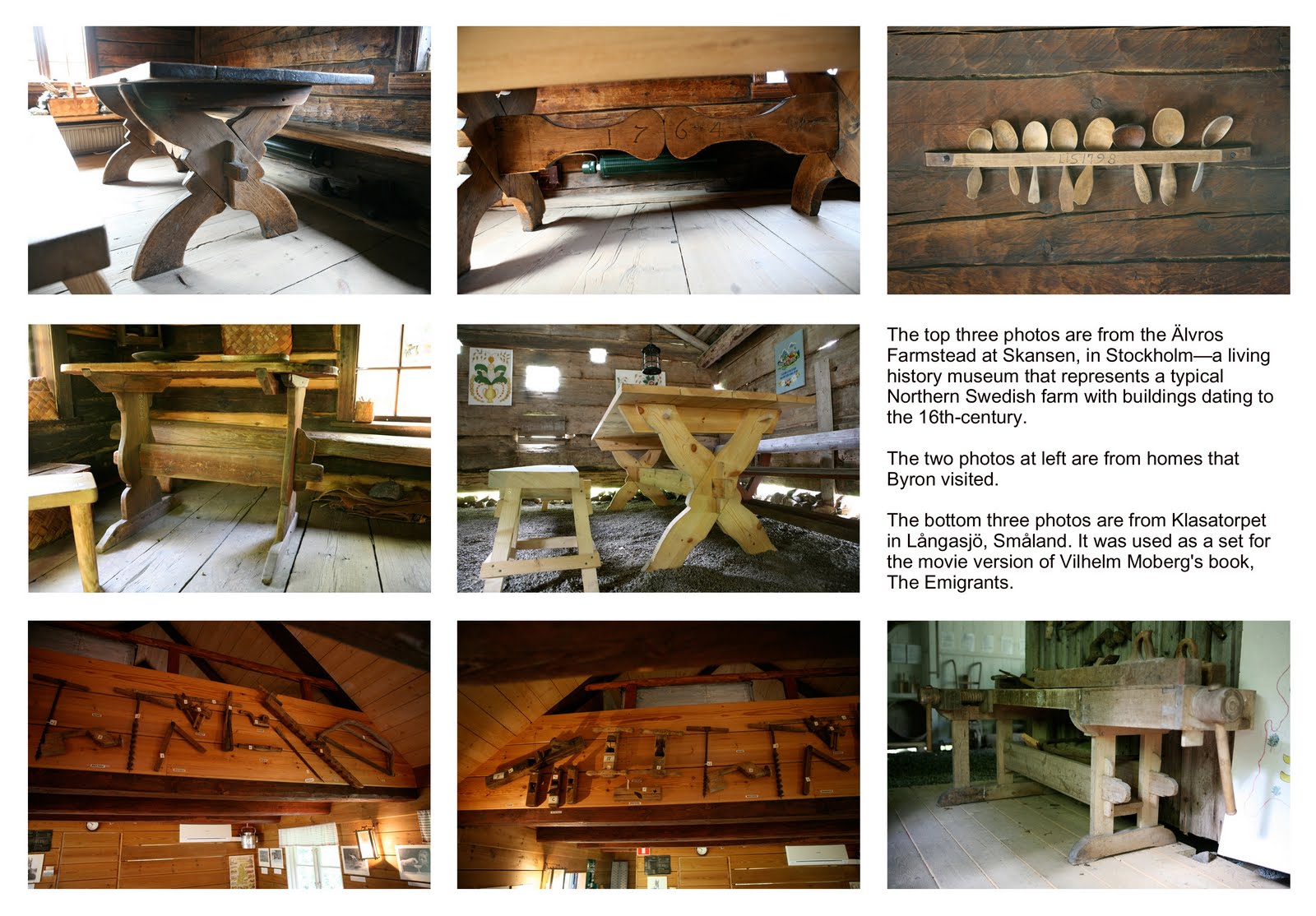
I've been looking for images that reflect the characteristics of old world folk and peasant furniture found in Sweden.

Thanks to an online friend, Byron Wiley, who belongs to a Scandinavian dance band in Lawrence, Kansas, these images have found me.

Byron recently returned from a month-long trip to Sweden, where he snapped a number of photos of just the types of pieces I've been looking for.

All of the photos in this post and all of the accompanying information have been supplied by Byron, to whom I am enormously indebted.

To read more about the places referred to in the photo pages, visit the websites for the Älvros Farmstead and the Nordiska Museet.

Wednesday, August 4, 2010

The Studley Tool Chest


A peak inside this magnificent tool cabinet, thanks to a video made by Norm Abram (and the person on the Old Tools Forum who posted the link).

Norm shows off the interior here.

Thank you to Dean, who posted this link in the comments section, where you can read more about the tool chest.

Monday, August 2, 2010

Five Spots Left For WIA

If you've been vascillating about whether or not to attend the Woodworking In America Conference this October in Cincinnati, you might want to make your final decision sooner rather than later.

There are only five spaces left for the conference and you have until midnight tonight to save $40 on the early bird special.

Saturday, July 31, 2010

Fox Wedged Tenon

Fox wedging is a joinery technique for a mortise and tenon joint where the wedge is fitted into a sawn kerf in the tenon. As the tenon is driven into the mortise, the wedge flares the split tenon and locks it in place.

High definition version of the video below can be found here.


One commenter asked if I had bored a flared hole to match the flared tenon. I did not. But you can cut a dovetail-shaped mortise, as shown in the illustration at right, which makes for a very strong joint. In the case of the drawer pull, I felt that the extra strength wasn't necessary.

The illustration is from this website.
The music is "Somewhere Over The Rainbow" by Israel Kamakawiwo'ole.

Tuesday, July 20, 2010

Cool Medieval Chests


If you read the Lost Art Press Blog, you may have seen a link posted by one of the commenters on this entry.

If you like carved Medieval chests, be prepared to
spend a few long minutes here.

Don't say I didn't warn you.

Friday, July 16, 2010

Friday Fun With Photoshop

What's with the disturbing image? Read all about it here.

Wednesday, July 14, 2010

Bob Baker: 1954-2010

I'm very sad to learn of the unexpected death of Bob Baker.

Some of you may not have heard of him, but if you are a serious handtool collector or are deeply smitten with antique tools, I bet you have.

I met Bob for the first time last November and most recently saw him at the Brown Tool Auction in March. The first things you would notice about him were his rosy cheeks and his piercing, twinkly eyes—which were fixed in a perpetual smile.

Bob had a love for unusual, high-end planes. Two of his reproductions—the Thomas Falconer Plough Plane (of which he made a full and half size) and the Moisset Plane—are two of my favorites. He made the Moisset plane in 1983, his first attempt at carving.

His level of precision and attention to detail in repairing high-end antique tools earned him a well-respected reputation. I found out later that many collectors would entrust only him to repair their tools.

Bob also made some of the period antiques I love—17th century carved New England pieces. He split the logs by hand and worked with handtools to make authentic reproductions of pieces he studied in museums, taking great care to match each joint, nail, and detail of the originals.

Bob made some of the things that I've always planned to make someday (or at least try). He was someone I held in high esteem and with whom I felt a kindred spirit. Not only did we share the same taste in planes, furniture, and architecture, we both shared a love of all things quirky. Like Bruce Campbell movies. And hiding secret, goofy messages in our pieces. And being mischievous big kids.

In one of his reproductions (last photo), he changed the initials on the front of the case to "BP." The patterned carving from the original reminded him of baby penguins, so he hoped that "someday, some little kid will look at that box and say, 'Hey, those look like a row of baby penguin faces' and hopefully put what he sees with the initials and smile at the discovery."

In his last email to me, he said "I have two big carving projects coming up in the next year or so. In the meantime—plane making, some restoration on two Holtz lathes, and building six copies of the clockmaker's lathe in Plumier/Diderot. (Bow lathe that clamps to the edge of a table or bench. A sweet little diddy.)"

Bob was high-energy, bright, proficient, precise, and someone I admired and hoped to emulate.

Unfortunately, for me and for the rest of the woodworking world, we have lost another great. However, I feel so fortunate to have gotten to know him even a little bit.