Thursday, December 1, 2011

Storage Boxes

I took a break from more involved projects to make a quick storage box.

"Quick" turned into "Unnecessarily Complex"—a phenomenon that all woodworkers can relate to.

For example, I added quirk bead moulding along the edges with scratch stock (and had to make the scratch stock first). And rather than glue up four thin boards as a solid piece for the bottom, I decided to shiplap and bevel the individual boards.

The four separate boards look okay inside the box, but the bottom looks a little odd. Either one glued-up, beveled board or two sets of beveled boards with shiplap would have looked nicer.

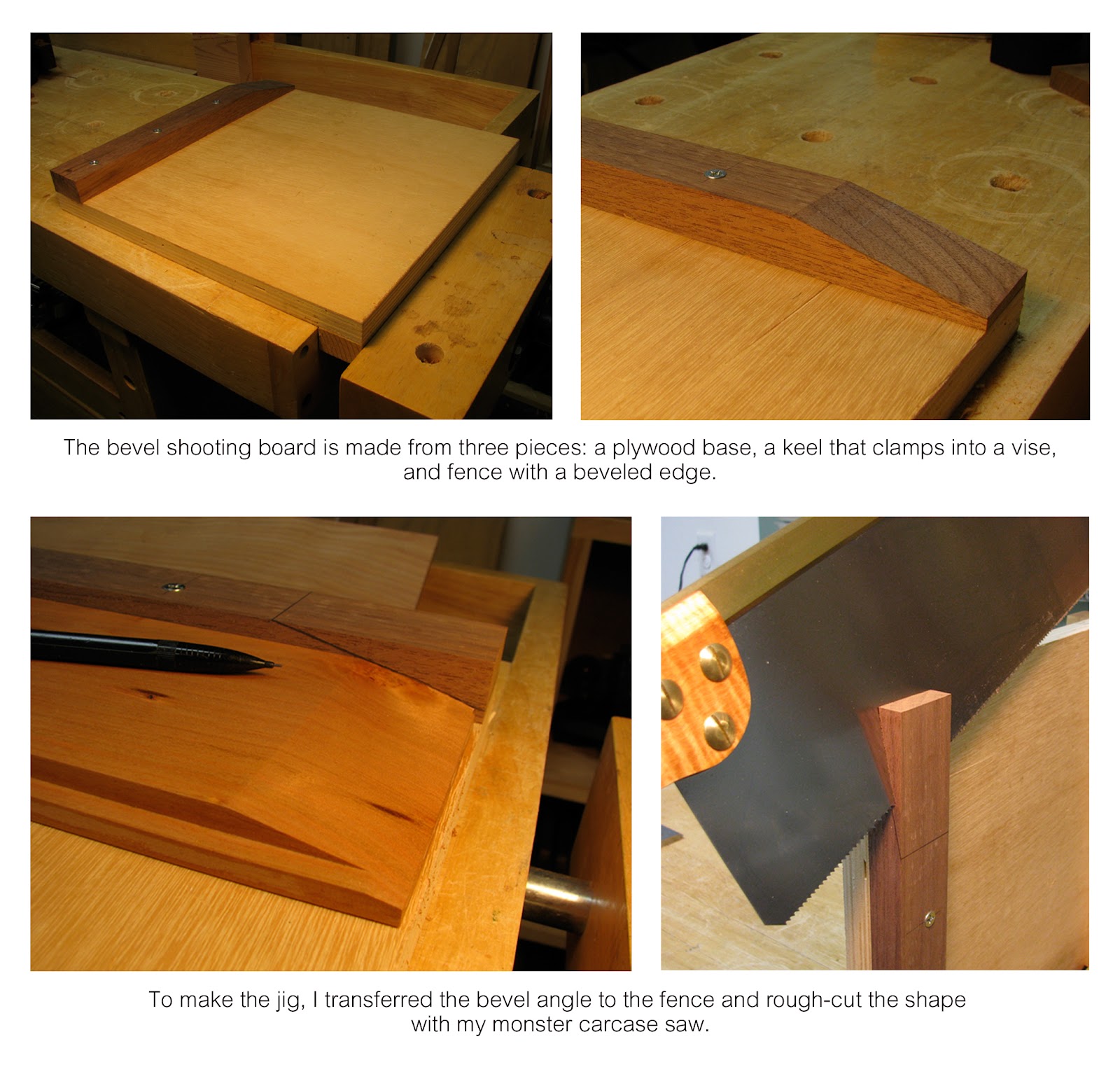
Finding a way to hold each board securely while planing the bevels was tricky. So, when I finished the boards for this box, I decided to build a shooting board so that the next storage box will move along more quickly (in theory).

There is nothing fancy or clever about my shooting board. It's comprised of three pieces: plywood for the base, scrap for the cleat, and squared-up piece of hardwood with bevel for the fence.

I used one of the boards that I had already beveled as a template for the fence. Then I used a carcase saw to remove the majority of the waste from the bevel.

I attached the fence to the baseboard with screws, and used a handplane to finish the bevel.

To use the jig, lay your workpiece alongside the fence with the ends aligned, and mark the bevel with a pencil. Transfer the marks to the top, sides, and front edge of the workpiece so you can easily see the waste area.

Use a handsaw to remove the bulk of the waste, then push the workpiece against the fence, and plane across the grain until you are close to your pencil marks.

At this point, slide the workpiece forward and plane with the grain until you reach your pencil marks.

Sunday, November 20, 2011

Ephrata Cloister

If you're considering giving up your secular life to become a brother or sister of the Ephrata Cloister, I have a few words of advice for you.

The sisters' dorm is five stories.


First, you might want to leave your aubergine zoot suit at home.  And your steak knife.  Leave that at home, too.  Oh, and never, ever get in a pillow fight with your brethren.

These things will help you get started as a follower of Conrad Beissel—a young baker who left the Palatinate region of what is now Germany to seek religious freedom in Penn's Colony in 1720.

Along his spiritual journey in Pennsylvania, Beissel joined a group of Anabaptists. But in 1732, he decided to become a hermit and find his own path.

He must have had quite a magnetic personality, because people followed after him and set up a camp nearby, and Beissel took on the role of spiritual leader.

He believed that men and women were equal, but should be separate and celibate—so the women had their own dorm and worship space, as did the men—and that all should wear white robes.

Still interested in joining the brotherhood?

As a new member, here's what you can expect. You'll start your day at 5:00 a.m. and work until 9:00 a.m. At that time, you'll stop to pray for an hour.  Notice anything missing? Yeah—breakfast.

At 10:00 a.m., you'll go back to work until 1:00 p.m., at which time you'll stop to pray. No lunch. Sorry.

Then you'll work from 2:00 p.m. to 6:00 p.m., and if you haven't fainted from malnourishment, you'll sit down to dinner. Hope you like vegetables.

Then it's work, work, work until 9:00 p.m. when you get to collapse into bed. Yep, now you can curl up on that cozy pine board measuring 18" wide x 6' long. Oh, and that 4" x 4" x 10" block of wood? That's your pillow.  Zzzzzzz

Up and at 'em! It's midnight, and we have to be ready for Christ's second coming.  So you'll worship for two hours, and at 2:00 a.m.—provided the Lord hasn't returned and whisked you off to heaven—you'll crawl back onto your board for three more hours and start all over again.

So why the harsh living arrangements? Here are Beissel's thoughts. God doesn't eat or sleep, so we should curtail our sleep and curb our appetites.  Deep sleep invites dreams where evil thoughts can enter our minds.  Regarding being celibate—each of you will "marry" God when you get to heaven, so why bother getting married here on earth?

At its peak, the cloister had 40 buildings, 250 acres, and 300 members.  The brothers worked a tannery and grain-, linseed-, paper-, saw-, and fulling mills. The sisters tended to the gardens, produced textiles, and drew ornate bible verses on large sheets of paper which were hung on the walls.

The buildings were built in traditional German style with steep roofs, dormer windows (that were randomly placed), and low doorways and ceilings. The shingles were tapered top to bottom and side to side.

The brothers and sisters were a benevolent bunch—feeding and giving (warm and comfy) beds to travelers for free. They also helped new settlers build homes and distributed goods to the poor. During the Revolutionary War, the sisters' dorm became a makeshift hospital where the brethren tended to 260 sick and wounded soldiers.

In 1813, the last celibate member died, and householders (non-celibate members who lived in homes near the cloister) took over caring for the property. In 1941, the state of Pennsylvania purchased the cloister and restored the buildings that remained.

Today, the cloister sits on 28 acres and has nine buildings that visitors can tour.

And if you're still thinking about becoming a brother or sister, you can even try out one of the "beds" during your visit. That might clinch your decision.

Saturday, November 5, 2011

Cutting Rabbets Without a Rabbet Plane

Like any task in woodworking, cutting rabbets by hand can be done a number of ways. It's all about stock removal. How you get there is a matter of choice and the tools you have in your shop.

I'm building simple storage boxes for the house which will be nailed and glued at rabbeted corners.  I tried a few different ways to cut them and settled on the following because it was relatively fast, accurate, and allowed me to play with a variety of hand tools.

First, I scored deep lines with my slicing gauge, outlining the section of wood that needed to be removed. The deep line created a crisp starting point for the shoulders on the inside and outside of the rabbet.

Next, I chamfered a relief at the far end of the rabbet to prevent tearout for the next step.

I shaved a shallow trench along the scored lines with my plow plane. This channel provided a guide for my crosscut saw. 

I sawed the near and far corners of the rabbet to final depth and then, tipping the handle up a bit, I used the front few teeth of the saw to cut the inside shoulder of the rabbet. I leveled the saw for the last few passes until I reached the final depth. 

I found that, rather than taking full passes with the saw from the very beginning, angling the handle up made it easier to steer the saw and keep the teeth close to the shoulder. 

The saw kerf provided a nice stop cut for the next move. Working from the edge of the board toward the stop cut, I used a chisel and mallet to remove most of the waste. 

When I was very close to the scored line on the edge of the board, I cleaned up the rabbet with a shoulder plane.

This method worked very well, but if you don't have a plow plane to cut the channel for your handsaw, you can clamp a board to your workpiece to use as a saw guide, or you can remove a sliver of wood by sliding a chisel along the scored line.

If you don't have a shoulder plane for the final passes, you can finish the entire cut with a chisel if you're careful. 

As another alternative, you just might happen to remember—after you've cut all the joinery—that you own a really nice moving fillester plane with skewed blade and nicker which would make quick work of the same task.

Wednesday, November 2, 2011

Antiquing Nails

Vinegar-treated on left; zinc on right.
I ordered some box nails from the Tremont Nail Company for another storage project. The nails were zinc-coated and shinier than I liked so I used a tip from Bob Rozaieski to antique them.

Two vinegar-treated nails. The one on
the left was buffed with steel wool.

Following his suggestion, I put a bunch of nails in a sealed jar filled with vinegar for about a day and a half. Through the glass I could see that the nails had darkened to a light charcoal color. The shiny zinc was gone.

The extra half day did not darken the nails, so one day would have been long enough.

Zinc/Vinegar/Vinegar & Steel Wool
I poured the vinegar out and laid the nails on a towel to dry. After about half an hour I checked them and found that they were coated in rust. If you rinse your nails with water right after the vinegar you will not encounter as much rust, according to Bob.

However, you may find that you like the rust color.  And the surface rust won't hurt the nails, so you can leave them as is.

For comparison, I buffed one of the vinegar-treated nails with steel wool to remove the rust and reestablish the dull, light charcoal color. Bob says the nails will continue to darken with age.

Zinc/Vinegar/Vinegar & Steel Wool
So you have a choice: bright & shiny, dull and gray (which will darken), or rust.

Depending on your taste or the look you're trying to achieve, you may prefer one over the others.

---------------------------
Bob made a short video about the aging process it here.
You can buy nails in smaller quantities from Tools For Working Wood.

Tuesday, November 1, 2011

French Woodworking Video from 1912

Here is a link to a French woodworking video from 1912 that shows students building period chairs.


The actual woodworking starts at 2:50, but the things leading up to it are worth a look. There is an interesting vise at 5:30, an unusual router/shaper at 6:50, and carving a 8:57.


Sunday, October 23, 2011

Simple T&G Bookshelf

Don't ask what possessed me to suddenly get organized, but I got it in my head one day that I wanted all my woodworking books and magazines in the shop and grouped into categories.

Sometimes even right-brained people like a little orderliness.

If you're like me, you have books and magazines all over your house tucked away in various nooks and crannies.  So, when I gathered them all together I realized I needed another bookshelf.

Because I had moved some machinery that I rarely use into the basement—full-size lathe, router table, hollow chisel mortiser, and belt/disc sanding center—I was able to move a utility bench away from a crowded corner to use as a work surface and to house some books.

In the spirit of simple boarded furniture, I decided to use nails for fasteners, rabbets and dados for the carcase, and tongue & groove joinery for the back boards.

This meant that I had the opportunity to use the new Lie-Nielsen tongue & groove plane* that I bought at a recent hand tool event.  What a fun handplane!  It's an ingenious design and works perfectly.

The bookshelf fits beneath the utility bench. It isn't fancy, but it is functional and practical, and was able to be built in a weekend due to the simple joinery.

-----------------
*I do not work for Lie-Nielsen nor do I benefit in any way from the sale of their tools. 

Monday, October 17, 2011

Workbench Inspiration

We can't help it.  Workbenches turn our heads, and quite a few got my attention at WIA.

Shannon Rogers brought his newly-built bench to his Hand Tool School booth.  Its height was determined by the measurement beneath the elbows of the vertically enhanced Shannon, who found this to be perfect for joinery work.

Chris Wong, of Time Warp Tool Works, added a handy planing attachment to Shannon's bench during the conference.

Across the aisle was Mark Harrell who must have some timberframing expertise on his list of skills given the design and joinery of both of his mammoth, knock-down benches.

Jameel Abraham brought two benches as well.  One was a sawbuck joinery bench that enabled conference-goers to take a spin with his smooth-as-silk Benchcrafted vises.  He told me that my sawbuck table inspired him. Cool.

Kevin Glen Drake brought an as efficient as it was handsome benchtop bench with leather-lined face vise.

Ron Brese's Shaker Workbench which he built with Jameel Abraham is a real beauty. He debuted it at last year's conference. Looks like he was able to remove the drool marks fairly well.

At the Hand Tool Olympics' booth, Mike Siemsen had made some quick and effective workholding devices for the handcut dovetail challenge.

Not at the conference but showcased at a Lie-Nielsen hand tool event at Hearne Hardwoods last weekend was a SAPFM member's portable bench. William Duffield had come up with some clever workholding solutions for the period projects he makes.

Wednesday, October 12, 2011

Cut Nail Sample Boards

Based on the comments (here, on other blogs, and on social networking sites) that followed Adam Cherubini's presentation on nailed furniture, it sounds like many of us are interested in working with period fasteners.

If you're looking for cut nails but are confused by all the varieties, Tremont Nail Company offers two sample boards* (one is card stock and the other is wood) which can be hung on the wall in your shop.

Each board comes with an actual sample of each the 20 different kinds of cut nails that the company sells. So you'll be able to decide exactly what you need for your projects.

--------------------

 *I do not benefit in any way from the sale of these sample boards. I ordered one today and thought you guys might be interested.