 Here are our next door neighbors. Poor little Frankenstein was scared of Sister Skeletor! (click on image to enlarge)
Thursday, October 25, 2007
Trick or Treat
Here are our next door neighbors. Poor little Frankenstein was scared of Sister Skeletor! (click on image to enlarge)


Tuesday, October 23, 2007
Cleaning Wood Furniture
Just bought an excellent book on wood finishing: Foolproof Wood Finishing, by Teri Masaschi.
In it, Teri explains the correct way to clean and maintain wood furniture. First, toss out the Pledge and furniture oils, such as Old English. These products merely put a superficial shine on your piece and smell good, but they do nothing to help restore or protect your furniture. In fact, they may attract dust.
Teri suggests regular dusting with either a slightly damp cloth or [better] a microcloth, that is 70% polyester, 30% polymide, lint-free, washable and non-abrasive, such as Miracle Cloths. For heavy duty cleaning, mix 1/8 to 1/4 cup Murphy Oil Soap in a half-gallon of water and wipe your furniture with a wrung-out cloth. Allow dampness to evaporate and apply paste wax.
Paste wax can be applied however often you like. She suggests purchasing a high-quality wax that is a blend of carnaba, beeswax, and sometimes paraffin. You don't want a wax that's too soft and smudgy, nor one that is too hard, like a bowling alley wax that will be difficult to buff out. She recommends Behlen's Blue Label Wax or Liberon's paste wax. Waxes come in different colors, so choose the one that is the closest color to the wood. Waxes produce a dry, non-greasy surface that does not attract dust and liquids tend to bead on the surface. When applying wax, work in small sections and buff out as you go; don't apply wax to the entire piece all at once. Apply a thin layer and buff out with a clean cloth (I use worn out socks and tshirts).
I've found that using cheesecloth with a small bit of wax folded up inside will apply the right amount of wax on the surface, a thin consistent film.
Another benefit to using wax is, if you decide to refinish your piece, wax can be removed easily with mineral spirits.
In it, Teri explains the correct way to clean and maintain wood furniture. First, toss out the Pledge and furniture oils, such as Old English. These products merely put a superficial shine on your piece and smell good, but they do nothing to help restore or protect your furniture. In fact, they may attract dust.
Teri suggests regular dusting with either a slightly damp cloth or [better] a microcloth, that is 70% polyester, 30% polymide, lint-free, washable and non-abrasive, such as Miracle Cloths. For heavy duty cleaning, mix 1/8 to 1/4 cup Murphy Oil Soap in a half-gallon of water and wipe your furniture with a wrung-out cloth. Allow dampness to evaporate and apply paste wax.
Paste wax can be applied however often you like. She suggests purchasing a high-quality wax that is a blend of carnaba, beeswax, and sometimes paraffin. You don't want a wax that's too soft and smudgy, nor one that is too hard, like a bowling alley wax that will be difficult to buff out. She recommends Behlen's Blue Label Wax or Liberon's paste wax. Waxes come in different colors, so choose the one that is the closest color to the wood. Waxes produce a dry, non-greasy surface that does not attract dust and liquids tend to bead on the surface. When applying wax, work in small sections and buff out as you go; don't apply wax to the entire piece all at once. Apply a thin layer and buff out with a clean cloth (I use worn out socks and tshirts).
I've found that using cheesecloth with a small bit of wax folded up inside will apply the right amount of wax on the surface, a thin consistent film.
Another benefit to using wax is, if you decide to refinish your piece, wax can be removed easily with mineral spirits.
Friday, October 19, 2007
Not Ready for Primetime Planes
 I have built a total of 7 handplanes, which does not make me a plane maker. I'm not sure what the magic number will be when I can claim that title, but I figure I will know it when I get there. That big pile of shavings was my attempt to plane the perfect shaving: no breaks and the full length of the board. Alas...
I learned to make handplanes from David Finck and Tod Herrli. David makes planes in the Krenov style and has written the best book on plan
 e making available. Tod is a master of making moulding planes and panel raisers. The panel raiser class I took from him at Olde Mill Cabinet Shoppe was four exhausting 10-hour days and worth every second.
While I still am not able to achieve the "perfect shaving", all of the
 planes I've made at least produce a shaving that you can read through.
Of the woods I've used to make the planes, bloodwood, osage orange, and beech have worked the best as far as durability (not wearing from use) and holding a sharp edge (meaning, when shaping the planes themselves, a cut into the wood will produce a crisp, clean edge). Applewood smells like cider when you cut it, but the wood moves a lot and I have to re-flatten the sole twice a year. Maple's great, just kind of boring.
Thursday, October 18, 2007
Kids & Woodworking
You'd be surprised what kids can make with wood, even at an early age. Bird houses, toys, puzzles, picture frames, shelves. There are several good books devoted to teaching woodworking to children.
I don't have kids of my own, but two other people and I helped the youth group at our church learn how to correctly use hammers, electric drills, and handsaws...and we and the kids loved it. Kids need to work with their hands. Learning woodworking at an early age builds confidence, mathmatical skills, eye-hand coordination, resourcefulness, and problem-solving skills. 10 year olds can be taught to use a scroll saw and younger children can be taught to use hammers, hand drills, hand saws, and all sorts of measuring tools.
Creating things with your hands is becoming a lost art in our younger generations, who instead prefer to sit in front of a computer or text their friends (I know how curmudgeonly that sounds, and I'm only 43!). If you have a child, I encourage you to build something with him or her. You'll be spending time together, you'll be creating something, and I guarantee that you both will benefit from the experience.
Link added 10.20.07 for kids and woodworking programs.
I don't have kids of my own, but two other people and I helped the youth group at our church learn how to correctly use hammers, electric drills, and handsaws...and we and the kids loved it. Kids need to work with their hands. Learning woodworking at an early age builds confidence, mathmatical skills, eye-hand coordination, resourcefulness, and problem-solving skills. 10 year olds can be taught to use a scroll saw and younger children can be taught to use hammers, hand drills, hand saws, and all sorts of measuring tools.
Creating things with your hands is becoming a lost art in our younger generations, who instead prefer to sit in front of a computer or text their friends (I know how curmudgeonly that sounds, and I'm only 43!). If you have a child, I encourage you to build something with him or her. You'll be spending time together, you'll be creating something, and I guarantee that you both will benefit from the experience.
Link added 10.20.07 for kids and woodworking programs.
Wednesday, October 17, 2007
Things I Learned...
...at the Women's Woodworking Club meeting last night:
1. It's legal to work inside your home completely naked and you can even walk outside your home and work in the yard, also naked. As long as you don't offend anyone, you won't be arrested.
2. It's possible to hold four simultaneous conversations, at the same table, with the same people, and everyone will hear what everyone else is saying.*
*this excludes yours truly, who obviously must be missing an x chromosome.
1. It's legal to work inside your home completely naked and you can even walk outside your home and work in the yard, also naked. As long as you don't offend anyone, you won't be arrested.
2. It's possible to hold four simultaneous conversations, at the same table, with the same people, and everyone will hear what everyone else is saying.*
*this excludes yours truly, who obviously must be missing an x chromosome.
Tuesday, October 16, 2007
The Nature of Woodworkers
(At the risk of sounding corny/naive/Gomer Pyle-ish): Just a quick comment on what I've found to be the nature of a vast majority of woodworkers (of course there are always exceptions, as in any group). They seem to be such a kind bunch of people, happy to share their woodworking knowledge. Without fail, every single famous woodworker to whom I have written—folks who write ww books, are contributing editors to ww magazines, and in one case, has his own ww show—have all written back, often within minutes of receiving my email, and have been eager to help.
I'm not sure if it's a particular personality type that is drawn to woodworking or if it's woodworking that brings out these traits in people. Nonetheless, it's a great community of which to be a part.
I'm not sure if it's a particular personality type that is drawn to woodworking or if it's woodworking that brings out these traits in people. Nonetheless, it's a great community of which to be a part.
Saturday, October 13, 2007
Progress Report
Two burly male friends came over yesterday to move the behemoth bookcase upstairs. Today, I installed the shiplapped and beaded back and moved it into its final position. Next, I'll build the crown molding and once that's added to the top, I can cross this one off my proj ect list.
Incidentally, that flag hanging on the wall belonged to my great grandparents, immigrants from Sweden. It's a pre-1912 flag with 45 stars and I'm sure it meant a great deal to them.
 ect list.
Incidentally, that flag hanging on the wall belonged to my great grandparents, immigrants from Sweden. It's a pre-1912 flag with 45 stars and I'm sure it meant a great deal to them.

Friday, October 12, 2007
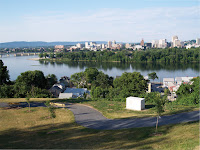
What a View!
Here is one of the many reasons I live in my tiny town: a spectacular view of the capitol city! Rich in history, my town was the most northern point the Confederate army reached during the Civil War.


Subscribe to:
Posts (Atom)


 Posts
Posts


